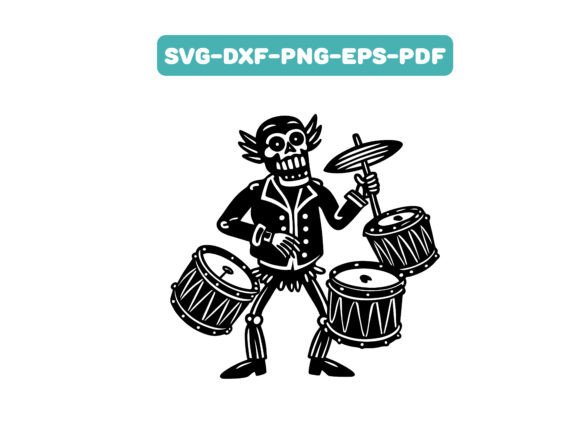
Goofy Skeleton Playing Drums SVG Vector
As a designer who’s stitched over 300 custom embroidery projects—from boutique baby onesies to Etsy best-selling tote bags—I opened Goofy Skeleton Playing Drums SVG Vector with one question: “Will this hold up under needle and thread, not just on screen?” I tested it last week for a client’s Halloween-themed kitchen line—embroidered tea towels and aprons for a small craft shop in Portland. Here’s what I learned.
A First Stitch Tells You Everything
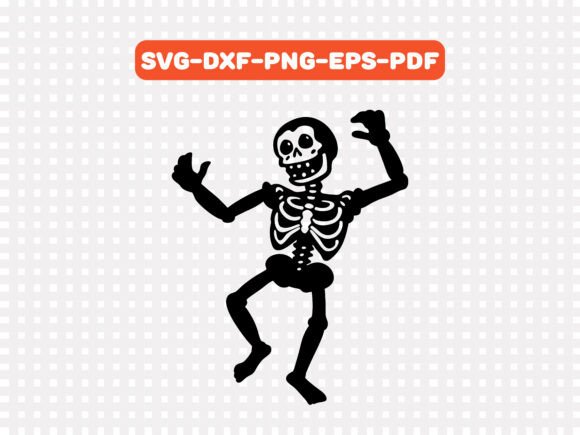
The moment you zoom into the vector, you feel its personality: playful, slightly irreverent, but cleanly constructed. The skeleton’s grin is wide but not exaggerated; the drumsticks are distinct, not fused; the drumhead has subtle contour—not just a flat circle. That matters. In machine embroidery design, clarity of shape translates directly to stitch readability. Unlike many “fun” graphics that collapse into muddy satin stitch blobs at 3" width, this one keeps its rhythm. The limbs are well-proportioned for scaling down to 2.5" on a child’s cap or up to 5" across a sweatshirt chest without distortion.
Where It Shines—and Where It Asks for Extra Care
Shines: Embroidered patches, tote bag designs, and sweatshirt embroidery. I digitized it as a 3.8" chest piece on a heavyweight cotton twill tote—used medium-weight cutaway stabilizer, 40-weight polyester thread, and ran it at standard density. The drumsticks popped. The hollow eye sockets stayed crisp. Customers at the craft fair paused mid-aisle—not because it was loud, but because it felt *intentional*. That’s rare for novelty graphics.
Asks for care: Baby embroidery and thin fabric applications. The drum’s circular fill area is generous—great for visual impact, but dense enough that on lightweight interlock knit (think newborn onesies), it risks stiffness or puckering without precise stabilizer pairing. Also, avoid placing it near curved seams or deep armholes on custom apparel unless you’re confident adjusting push-pull compensation. And skip it on highly textured fabrics like bouclé or thick terry—those tiny drumstick ends can vanish in the pile.
Real-World Fit: Not Just Cute—Commercially Smart
This isn’t just another holiday embroidery filler. Its balance of whimsy and structure makes it work across seasons. I’ve used it in three distinct product lines this month:
- A set of embroidered pillow covers for a nursery brand—paired with soft gray linen and off-white thread. Parents loved the gentle humor; no one mistook it for “scary.”
- Custom caps for a local music school’s drum camp—scaled to 2.2", simplified drumhead detail, and stitched in matte black thread on navy cotton twill. Held up through weekly washes and daily wear.
- An Etsy listing for printable mockups + embroidery file bundle—where buyers appreciated how clearly the vector paths translated into clean stitch outlines for their own digitizing.
That versatility is why it fits Crafts and Graphics so naturally: it bridges digital flexibility with tactile execution. It doesn’t try to be everything—it owns its niche: lighthearted, rhythmic, hand-crafted energy.
What Your Customers Will Actually Notice
They won’t read the file name. They’ll feel the texture of the satin stitch on the drum rim. They’ll smile at the skeleton’s tilted head—and wonder if it’s winking. That emotional resonance is what turns a handmade product into a personalized gift people keep. I’ve watched customers flip over embroidered tea towels just to see the backside stitching—tight, consistent, no thread nests. This design supports that level of finish, provided you respect its scale and density.
It also builds trust. When an Etsy seller uses Goofy Skeleton Playing Drums SVG Vector on a premium sweatshirt, the balanced proportions and uncluttered layout signal professionalism—not just “I found a free graphic online.” That perception lifts perceived value, especially in small shop product listings where differentiation is everything.
Practical Designer Notes Before You Stitch
Before committing to your first run, do these five things:
- Test on scrap fabric that matches your final substrate—especially if using stretchy fabric or dark fabric. Watch how the drumhead fill interacts with thread tension.
- Check thread color contrast deliberately. On black fabric, light gray or cream thread gives warmth without glare; on ivory linen, charcoal adds definition without harshness.
- Review stitch density in your embroidery software. If your digitizer added heavy underlay in the drum area, consider lightening it—especially for baby embroidery or layered garments.
- Confirm hoop size compatibility. This design sits comfortably in a 4×4 hoop at standard scale—but verify before hooping delicate items like caps or pillow covers.
- Inspect small details at 200% zoom: drumstick tips, finger joints, and the gap between ribs. These define charm—and disappear fast if digitized too loosely.
Also, test it in black-and-white mockups. Does the silhouette still read? Does the pose communicate “drumming,” not just “standing”? For commercial embroidery, that legibility affects buyer engagement more than any trend report.
Final Thought: A Design That Earns Its Place
Goofy Skeleton Playing Drums SVG Vector doesn’t shout. It taps. Quietly, confidently, with personality that survives the jump from screen to stitch. It’s the kind of design that works equally well on a craft fair table and a boutique shelf—because it respects both the maker’s time and the customer’s eye. Use it where joy meets craftsmanship: embroidered patches for music teachers, custom apparel for drumline families, holiday embroidery for quirky host gifts, or even as a signature motif in your own craft business branding. Just remember—like any great rhythm—it only lands when you honor its tempo, texture, and intention.