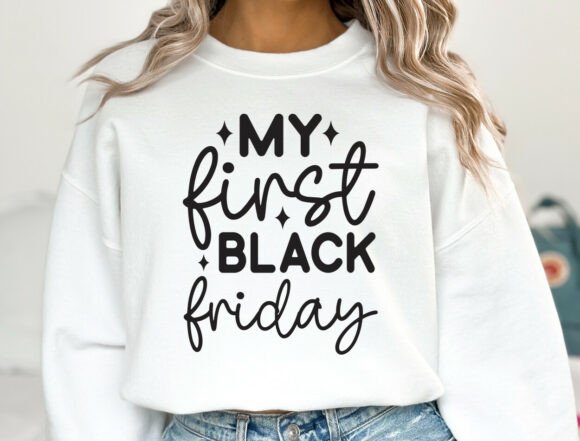
My First Black Friday SVG
A Designer’s Real-World Check Before Stitching
I pulled up My First Black Friday SVG last week while prepping a batch of holiday-themed embroidered tote bags for my small shop — the kind customers grab as hostess gifts, boutique merch, or personalized “treat yourself” keepsakes. Right away, I noticed it doesn’t scream “sale frenzy.” Instead, it carries a warm, slightly nostalgic charm — clean lines, friendly lettering, and just enough visual weight to read clearly at 3–4 inches wide. As a machine embroidery designer who’s stitched hundreds of holiday and seasonal graphics, I don’t reach for novelty files on instinct. I assess how they’ll hold up *after* the needle stops: Will the corners crisp? Will the text stay legible on a textured sweatshirt? Will it feel handmade — not mass-produced — when someone unwraps it?
What This Design Naturally Wants to Be
My First Black Friday SVG leans into simplicity with intention. It’s not built for dense fill-stitch coverage or intricate satin borders — and that’s a strength. It reads well as an embroidered patch, a centered chest design on a baby onesie, or a subtle accent on a linen tea towel. I tested it digitally over mockups of oatmeal-colored canvas totes, heather grey sweatshirts, and soft cotton baby blankets. In every case, it landed with approachable authenticity — like something a craft business owner would choose for a curated holiday collection, not a flash-sale fire sale.
It’s also flexible across audiences: the rounded letterforms soften the “Black Friday” message enough to feel inclusive for kids’ apparel (think: toddler joggers or embroidered bibs), while the balanced layout keeps it polished for boutique aprons or women’s lounge wear. As a Graphics asset, it bridges Crafts and commerce — but only if treated thoughtfully.
Where It Shines — And Where It Needs Guardrails
This design works beautifully on stable, medium-weight fabrics: twill tote bags, fleece-lined hoodies, cotton-blend tea towels, and structured caps with proper stabilizer backing. On those surfaces, the stitch density stays manageable, corners stay defined, and thread color contrast remains clear — especially with a mid-tone thread like charcoal grey or navy on cream or light heather.
But here’s where real-world testing matters: My First Black Friday SVG isn’t ideal for ultra-small hoop sizes (under 3 inches tall) without simplification. Tiny serifs or fine interior spacing in the lettering can blur on stretchy fabric like jersey knits or thin baby rib knit — especially after washing. I wouldn’t use it full-size on a curved cap front without adjusting placement and stabilizer layers. And on dark fabric? Always test your thread choice first — some lighter fills lose definition without a white underlay or adjusted stitch order.
Practical Notes Every Embroidery Designer Should Run Through
- Test on scrap fabric first — especially if stitching on textured or loosely woven material like terry cloth or bouclé.
- Check thread color contrast in natural light *and* on-camera — what looks bold on screen may mute on fabric.
- Review stitch density before scaling beyond 4.5 inches; denser areas can pucker lightweight fabrics.
- Confirm hoop size compatibility — this is an SVG file, so you’ll need to digitize or convert it for embroidery machines. Don’t assume auto-digitizing tools will handle spacing or underlay correctly.
- Inspect small details at actual stitch size: tiny counters (like the “e” or “a”) may close up or distort without manual cleanup.
- Test black-and-white mockups to see how it reads without color crutches — crucial for Etsy listings and printable mockups.
- Compare light vs. dark backgrounds — not just for visibility, but for perceived value. A well-executed My First Black Friday SVG on charcoal linen reads premium; the same on cheap black poly might look flat.
- Use appropriate stabilizer: cutaway for knits, tear-away for stable wovens, and fusible + tear-away combo for lightweight baby items.
- Verify licensing terms before selling finished products or bundling it as part of a digital embroidery file pack — since it’s labeled for men, women, kids, and baby use, commercial rights appear broad, but always double-check.
How It Shapes Customer Trust and Brand Feel
When a customer sees My First Black Friday SVG stitched cleanly on a hand-finished pillow cover or a limited-run sweatshirt, it signals care — not haste. That matters. In a market flooded with generic holiday graphics, this design avoids cliché. It doesn’t shout “DISCOUNT!” — it whispers “this moment matters.” That subtlety builds trust, especially for Etsy sellers and small shop owners whose buyers value intention over impulse.
For personalized gifts or boutique branding, its flexibility helps maintain consistency: same design, scaled and threaded differently across baby onesies, adult aprons, and linen napkin sets. It doesn’t dominate — it complements. And because it’s rooted in clarity, not clutter, it photographs well in natural light, which lifts your entire product presentation.
Final Thought: A Quietly Confident Choice
My First Black Friday SVG won’t win awards for technical complexity — and it shouldn’t. Its value lies in restraint, readability, and quiet versatility. It’s the kind of embroidery file I keep in my “go-to seasonal folder” — not for every project, but for the right ones: thoughtful handmade products, cohesive small-batch collections, and personalized gifts where warmth and clarity matter more than flash. If you’re a craft business owner building a recognizable aesthetic — or an embroidery designer choosing assets that reflect skill, not just speed — this one earns its place. Just remember: treat it like a sketch, not a stamp. Digitize with purpose. Stabilize with care. And always, always test before the first customer order hits.